





![]() |
||||||||||||||||||||||||||||||||||||
![]() ![]() ![]() ![]() ![]() ![]()
|
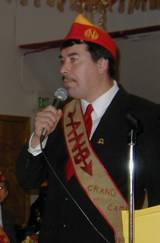
John Nault's Party -
Photo Gallery The ANB/ANS has been extremely busy with personal and Camp activities. Past events include:
|
|||||||||||||||||||||||||||||||||||
|
|
|||||
| Info: For more information, contact Clement Lam
(F.A.N.) at (250) 973-6274 or (604) 760-6028. Want to know the truth about farmed salmon? * Farmed salmon are raised in large floating open netcage systems in the marine waters and impact wild salmon and other marine species by spreading disease and parasites. * Farmed salmon are fed with drugs, pesticides and more antibiotics by weight than any other livestock possibly contributing to the dangerous increase in antibiotic-resistant disease worldwide. The drug-laden wastes from surplus food and feces pollute the marine environment. * Farmed salmon - mostly alien Atlantic stocks - escape from their netcages, often by the thousands, and can out compete and displace fragile wild stocks from their habitat. Atlantics have been found inabout 80 rivers. * Farmed salmon contain higher levels of unhealthy saturated fats and lower levels of beneficial omega-3 fatty acids. Farmed Atlantic salmon contain 200% more saturated fat than wild Pacific pink or chum salmon. Farmed salmon also appear to contain higher levels of PCBs and dioxins. * Farmed salmon represent a 'net loss' of protein worldwide: it takes three times the amount of fish eventually 'produced' to feed the farmed salmon. * Farmed salmon have greatly reduced the price of wild salmon, directly impacting the livelihood of local fishermen. Small-scale netcage salmon farming in B.C. began in the early 1970s. Today salmon farms are controlled by a handful of multinational corporations, mostly Norwegian-based. They are found along the coast of British Columbia, with the heaviest concentration in the Broughton Archipelago off northern Vancouver Island. They vary in size and a single farm may contain up to a million fish. Unknown tonnage of uneaten fish feed, antibiotics, pesticides, and raw sewage from the fish farms are constantly being dumped at sea unchecked, untreated and unregulated. The dumping upsets the natural balance in the surrounding sea, which leads to the outbreak of disease and contamination. In addition, hundreds of tons of dead, diseased farmed fish and other waste are dumped on land. Fish farms threaten everything in their path. Bright night lights are used by fish farms all winter and spring to promote rapid growth of farmed salmon thereby attracting the smolts of wild salmon as well as other creatures, setting up a feeding frenzy and resulting in severe wounds to the fish and facilitating lice attachment. Fish farmers are permitted to kill seals and sea lions which try to prey on the farmed salmon: In 2001 alone, 400 seals and sea lions were killed. Alternately, some farms are equipped with Acoustic Harassment Devices. Those devices are so damaging that they may cause deafness in marine mammals and therefore some species of whales are driven from their habitat. |
|||||
| Web posted Friday, April 23, 2004
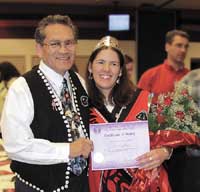
Pageant recognizes Native leadership Rose Natkong of Pelican won the 2004 Miss Tlingit Haida Youth Leadership Pageant that was held April 16 at the Alaska Native Brotherhood Hall in Juneau . Natkong was one of six contestants who participated in activities from April 14-16. First runner-up was Madeline Soboleff-Levy of Juneau , and the second runner-up was Amelia Rivera of Juneau . The other participants were Stacey Roberts of Juneau , Koren Ruth DeBell of Kake and Brooke Y. Leslie of Wrangell. Pageant activities included regalia making with Alberta Aspen, a University of Alaska Southeast campus tour and interviewing techniques with Janice Holst. The contestants had to turn in a pageant application, a 15-minute interview with the judges and a presentation. As part of their presentation, the contestants were required to introduce themselves by identifying their clan, family and Tlingit and/or Haida names. They were also asked to describe their regalia and present a traditional activity or speech. Natkong, 20, is the daughter of Rodi Young and Rose Miller of Pelican. Natkong is Tlingit and Haida, Eagle Dakl'weidee Killerwhale, and a graduate of Mt. Edgecumbe High School in Sitka . She attends the University of Alaska Southeast . "This is our third annual Miss Tlingit Haida Youth Leadership Pageant," pageant coordinator Jackie Tagaban stated in a press release. "I am very pleased with the success we have had so far.
|