Aging is one of the few experiences that is both deeply personal and entirely universal.
If we are fortunate, we grow older. We notice small changes first — a little more effort getting out of a chair, a second look at a medication label, a new awareness of balance or memory. Over time, aging reshapes routines. It invites new kinds of independence and, sometimes, new kinds of support.
Most of us will also find ourselves caring for someone older — a parent, a partner, a friend. We will learn how much daily life depends on small, steady acts: a reminder, a lift, a check-in call, a quiet reassurance.
And now, woven into that everyday reality, is artificial intelligence.
AI is already drafting emails and diagnosing diseases. But its most meaningful role may not be in laboratories or corporate boardrooms. It may be in homes — helping someone live safely, stay connected, and remain independent longer than was once possible.
The question is no longer whether technology will shape aging.
It already is.
The more important question is this:
How can we ensure it does so in ways that strengthen dignity, connection, and choice?
Rethinking What “Value” Means
For Jing Li, Associate Professor of Health Economics and Associate Director of The CHOICE Institute, the word “value” sits at the center of this conversation.
“In the current era,” she explains, “the unprecedented speed at which new technology develops — including advances in AI — has prompted policymakers, researchers, providers, and end users to look for ways to leverage these technologies to maximize their value.”
But value, she emphasizes, is not just about innovation.
“Value, at its core, involves both cost and benefit.”
That balance is broader than it sounds. Benefits include not only technical breakthroughs, but practicality, scalability, sustainability, and ease of use. Economists also look at what Li calls “marginal benefit” — the real, measurable improvement beyond what we already have. Does a tool meaningfully reduce falls? Improve medication adherence? Ease caregiver stress?
Costs are layered, too. There is the price of the technology itself, but also the time required to learn it, the adjustments in workflow, and the systems needed to support it. Trust and ethics, Li notes, cut across both sides of the equation. If people feel confident and respected, value increases.
The goal is not simply to build smarter tools. It is to build tools that make life better — in ways that are tangible and lasting.
Supporting the People Who Support Us
When we talk about aging, we often focus on older adults themselves. But caregiving is part of the picture — and often an invisible one.
For Karen Eggleston, Director, Asia Health Policy Program, Shorenstein Asia-Pacific Research Center, Stanford University, one of the most promising aspects of AI and robotics lies in how they can support care partners.
“One aspect that might be often overlooked,” she says, “is that AI and robotics can bring value to older adults through supporting their care partners — relieving the stress, time burden, or even the back pain of caregivers.”
That support can be transformative. A robotic lift that prevents injury. A digital platform that simplifies coordination. A monitoring tool that provides reassurance from a distance. Small improvements in caregiver burden can ripple outward — preserving energy, patience, and emotional bandwidth.
Eggleston underscores the importance of evidence to ensure these tools truly help. “For assessing value, it will be critical to gather evidence about what works in practice — including both the intended and unintended consequences.”
Done thoughtfully, technology has the potential to make care not only more efficient, but more humane.
Independence, With Support
For Shuai Huang, Professor, Department of Industrial & Systems Engineering at the University of Washington School of Engineering, the measure of success is clear.
“To define value in aging technology,” he says, “the primary metric should be how effectively a tool enhances an older adult’s quality of life, independence, and dignity — according to their own personal goals.”
That focus shifts the conversation. It reframes AI not as a replacement for human care, but as a partner.
“There’s a trade-off between a device providing ‘security’ for a clinician versus ‘surveillance’ for a senior,” Huang explains. Designing thoughtfully means ensuring safety without sacrificing autonomy.
Generative AI and digital tools are already enabling more proactive models of care. Sensors can detect subtle changes in routine. Predictive models can flag risks before they escalate. Virtual companions can supplement social engagement, especially for those aging alone.
The key, Huang believes, is inclusion. When older adults are invited into the design process — when their voices shape the tools meant to serve them — trust grows. The result is what one design participant described as an “ultimate partnership” — technology that feels made for me.
From Innovation to Real Life
In hospitals and long-term care settings, even the most promising technologies must prove themselves in the complexity of daily life.
For Oleg Zaslavsky, Director of the Digital Health Innovation Hub and Associate Professor in Aging, Biobehavioral Nursing at the University of Washington School of Nursing, value comes down to what people experience.
“Value should center on functional independence, caregiver burden, and quality of life — not just utilization or cost offsets,” he says. “True value in aging care must integrate both.”
AI now allows clinicians to detect patterns — changes in speech, movement, or behavior — that were previously invisible. That capability opens the door to earlier intervention and more personalized support.
At the same time, thoughtful implementation matters. Technology works best when it integrates smoothly into existing workflows and respects the people using it — from nurses to family members to older adults themselves.
When done well, these tools do not dominate the experience of aging. They recede into the background, quietly extending safety and support.
A Hopeful Future
If there is a through line in these conversations, it is this: technology should strengthen the experience of aging — not complicate it.
The most powerful tools may not be the flashiest or most visible. They may be the ones that quietly extend independence. The sensor that prevents a fall. The algorithm that catches a subtle health shift early. The digital platform that lightens a caregiver’s load. The interface that feels intuitive rather than intimidating.
Shuai Huang imagines a future in which AI becomes “an empowering, quiet partner — omnipresent yet never overbearing.” Success, he says, would sound like this: “I live alone, but I never feel alone or helpless.”
It is a modest vision, and that is precisely its strength.
Aging does not need to be reengineered. It needs to be supported — with tools that respect autonomy, preserve dignity, and make everyday life safer and more connected. When technology aligns with those goals, it expands choice rather than narrowing it.
The GenAI era offers extraordinary capability. The opportunity now is to apply that capability with care — designing systems that meet people where they are, that adapt to real lives, and that remain accessible beyond early adopters.
If we do that well, the future of aging will not feel futuristic at all.
It will feel steady. Supported. Human.
And perhaps most importantly, it will feel like life — continuing forward, with confidence and connection.



 Olivia Yip, 2nd Year MS Fellow

 The National Academy of Medicine (NAM) has selected the UW School of Pharmacy’s Jennifer Bacci, Endowed Associate Professor in Innovative Pharmacy Practice, as one of seven outstanding health professionals for the class of 2024 NAM Fellowships. The fellows were chosen based on their professional qualifications, reputations and accomplishments, and the relevance of their current field expertise to the work of the NAM and the National Academies of Sciences, Engineering, and Medicine.
 A very special congratulations to Jennifer Chang, Seohyun “Claudia” Choi, Jennie Do, Karan Dawson and Leigh Ann Mike, who will receive UW’s Distinguished Teaching Award for Teams at the 53rd annual Awards of Excellence Ceremony next month. Each year, the awards honor outstanding alumni, faculty, staff, students and retirees who contribute to the richness and diversity of our University community. The ‘Distinguished Teaching Award for Teams’ is a new honor granted to outstanding instructional teams.

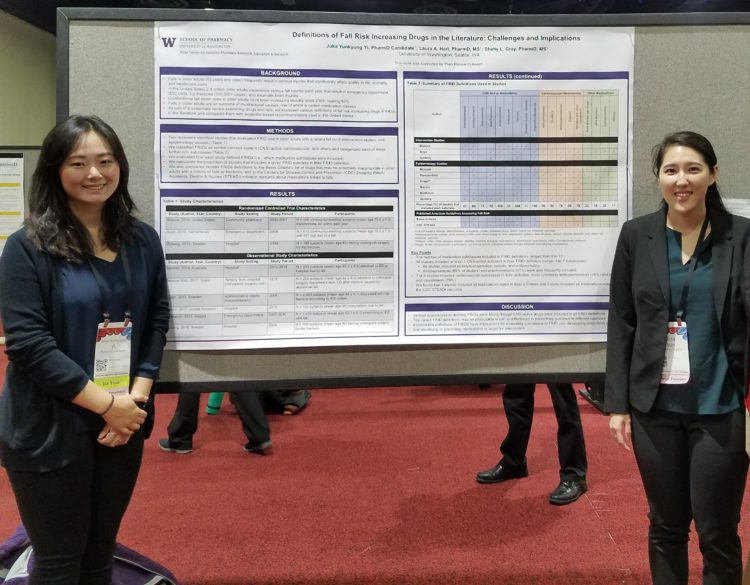
 Michelle Nguyen (PharmD Candidate 2023) and Shelly Gray presented a poster (co-authored by Abby Winter, Assistant Director for Outreach for the Plein Center) at the ASCP Annual Meeting entitled “Understanding Older Peoples’ Knowledge, Perceptions, and Self-Motivated Health Behaviors Regarding Use of OTC Anticholinergic Medications: A Focus on Assisted Living Community Residents.”
 Joy (Bickmore) Plein, ’51, ’57, a beloved UW School of Pharmacy colleague, mentor and true pioneer in the field of geriatrics, passed away peacefully at Virginia Mason Medical Center on February 19, 2021. She was 97.
 The Pharmacy Leadership and Education Institute has named UWSOP’s Jennifer Bacci the 2021 recipient of the Albert B. Prescott Pharmacy Leadership Award. Dr. Bacci is recognized for her outstanding leadership example in the Academia-CPESN Transformation (ACT) Pharmacy Collaborative Task Force by the American Association of Colleges of Pharmacy (AACP), as a Flip the Pharmacy coach, and as a network facilitator for Community Pharmacy Enhanced Services Network (CPESN) Washington.
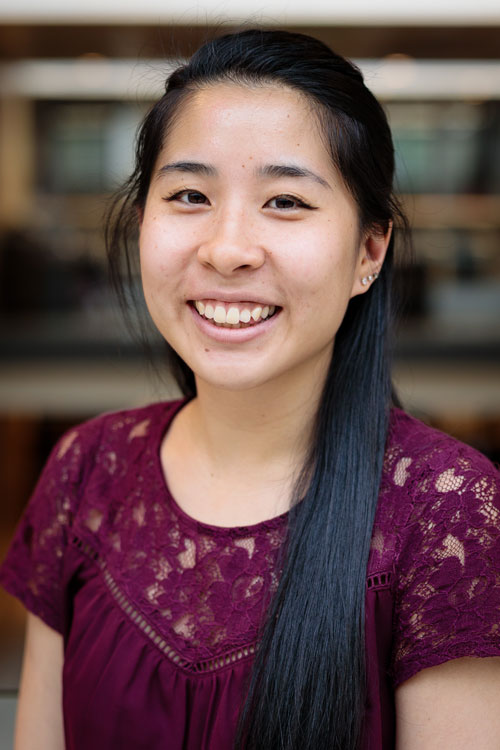 Lena Chaitesipaseut, a Plein Scholar and class of 2021 PharmD-MBA student, was recently awarded a $4,000 scholarship from the UWRA. In addition to this prestigious honor, Lena has been selected to complete an APPE rotation in August at the ASCP national office in Alexandria, VA. Her focus will be on professional association leadership and education management.

 Jackie Gardner | Epidemiologist & Legendary Advocate for Increased Access to Care
 Don Downing, ’75 | Advocate for Pharmacy and Women’s Reproductive Health
 Jennifer Bacci | Assistant Professor & Community Pharmacy Researcher
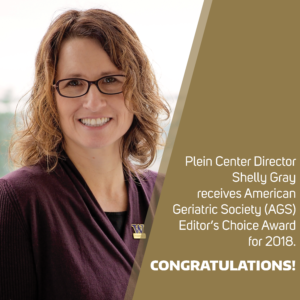 Congratulations to Plein Center for Geriatric Pharmacy Director Shelly Gray who received the The American Geriatrics Society Editor’s Choice Award for her paper that showed Protein Pump Inhibitors (PPI) are not linked to higher dementia risk.
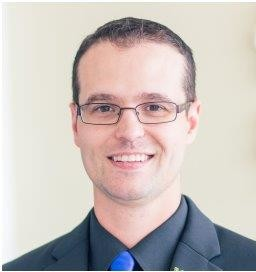


 While competing the postdoctoral fellowship in geriatric pharmacy here at the UWSOP, alumna Laura Hart, PharmD, MS, BCPS, BCGP,’14, ’17, was awarded a research grant by the American College of Clinical Pharmacy (ACCP) Research Institute Futures Grants program. Her research focused on the impact central nervous system (CNS)-active medications have on older adults with dementia. She was particularly interested to see how these medications affect the risk of falls in this population. From that research, she published, “The Association Between Central Nervous System-Active Medication Use and Fall-Related Injury in Community-Dwelling Older Adults with Dementia,” in the journal, Pharmacotherapy.

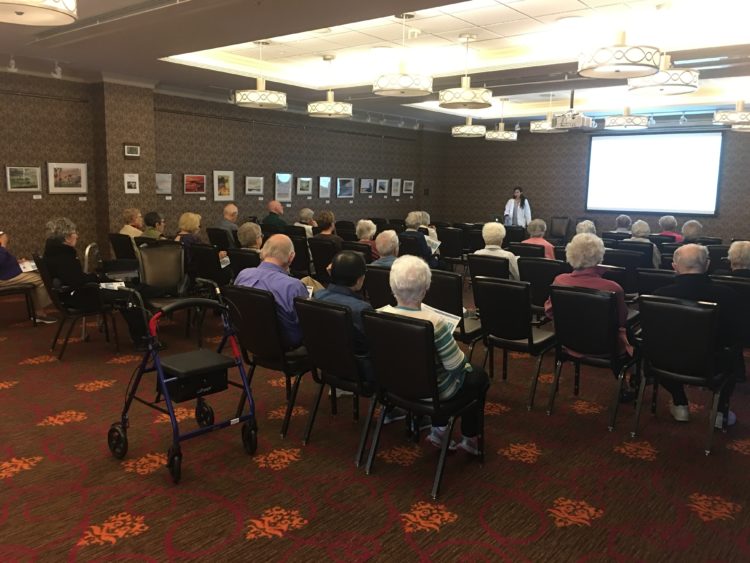
 Era Living communities are active and have many life-long learners as residents, including retired UW faculty. UWSOP and Era Living have a partnership designed to support residents’ health and create learning opportunities for our student pharmacists, under the mentorship of our faculty. Students and faculty regularly give well-attended talks on different subjects to empower the staff and residents in their own care. Topics include what to do to prevent contagious illnesses like pneumonia, whooping cough, and more.