 Sorry this frame doesn't stand out well from the background.
In November 2001, while shopping for a new spotting scope for birding, I got distracted and bought an outrageously cheap astronomical telescope, an Orion StarMax127. It's a pretty limited scope, but not the worst thing for the size or the price.
When considering a first scope purchase, the obvious questions are what can be seen and how good will it look? It is hard to get a good answer to this for several reasons, among them:
-The astrophotos you see are usually made with a scope bigger and/or more expensive than yours. There is NO SUBSTITUTE for cubic dollars!
-Your eye has to capture light in "real time" to form an image updated many times per second, while film or CCD cameras used to create astrophotos can be exposed for seconds, minutes or hours to form one image, revealing detail and color that the eye can't detect at such low light levels.
-There is little incentive to make images look as "bad" as the way you see them. On the contrary, many CCD images taken in rapid succession are often combined to maximize detail. Almost no one wants to publish images detuned to match a cheap telescope's visual offering.
-Pencil sketches are generally considered the best way to represent what your eye sees. But, even ignoring the problem of the variation you would expect in sketches of the same object by different observers, it is impossible for a newbie to really understand how a sketch estimates the view, any more than a newcomer to photography could look at a negative and clearly envision what the print will look like. Admittedly, if you find the sketch boring, that may be a good predictor...
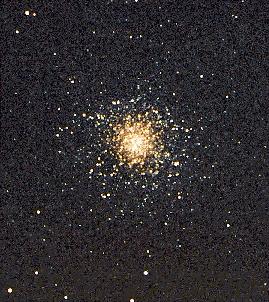
I took a stab at editing some images of globular cluster M13 to look more like what I saw in the scope last night (4/30/02). One of the original images, by Jason Ware (swiped from http://www.seds.org/messier/more/m013_m2.html):
Sorry this frame doesn't stand out well from the background.
This image and another from the same source after I finished battering them in Photoshop:
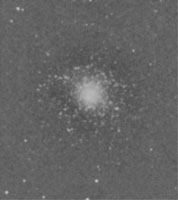
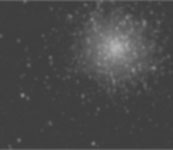
The method consisted primarily of liberal use of Blur and Blur More, and Adjust Brightness/Contrast (increasing the brightness and decreasing the contrast). Note that the bright grey background is NOT a feature seen in my scope, but I was trying to duplicate the stellar resolution at the expense of wrecking the actually constrast of the background and isolated stars. These both still show more stellar resolution than I actually could see last night (4/30/2), but they are not too far off. Seeing conditions were pretty poor, so I'm hoping these will be more nearly equalled by my view another night.
Some of my observing notes.