|
|
|
|
|
Born in Dallas 1920 |
|
Middle Class Family |
|
Segregationist at that time |
|
This area has been described as “the place where
the south continues…” |
|
Came from Irish & Dutch Heritage; his
father’s family is Baptist, his mother’s Episcopalian |
|
|
|
|
In Junior High he became frustrated by the
limited curriculum of public school |
|
He spotted a newspaper ad for a boy’s school in
France and begged the school master to let him in |
|
Six months later he received a letter admitting
him |
|
Despite the fact that his parents could only
send him one way, he went |
|
|
|
|
|
|
As he says: |
|
“I had the Black Mammy…and the kind, Southern,
slave owner mentality was drilled into me…and we were given the destructive
illusion that Negroes were somehow different. We were horrified in lynching, [and yet], in a way we were
practicing slavery everyday.” |
|
|
|
|
|
A couple of events triggered Griffin’s awareness
of his own racism |
|
In France, he once remarked how he was surprised
a Black was allowed in the café.
His friend remarked “why?”
he honestly could not answer and suddenly realized his own prejudice. |
|
He slowly realized that although benevolent, the
attitudes sustained by his family were still racist. |
|
|
|
|
|
|
During his time in France, he began working at a
Medical Facility when Germany began an assault on the Borders |
|
He joined the underground resistance movement
with other students trying to hide Jewish refugees to smuggle out of the
country |
|
He could clearly see the “racism” and evil in
the discrimination of the Jews, but could not somehow make the connection
to Blacks in the South. |
|
|
|
|
Griffin would later recall that “”If he had” at
that time “perceived any connection between anti-Semitism and white racism,
he would have associated the Nazis with the Ku Klux Klan” |
|
|
|
Following a failed attempt to smuggle an
Austrian family out of the country, he was discovered. His friend was killed fighting for the
Free French Army and Griffin and fled to Ireland to await passage back to
America. |
|
|
|
|
Griffin could not sit idle in Texas while a war
raged on |
|
He joined the Air Force and because of his
linguistic skills was chosen to go to a island to help keep the villagers
loyal to the U.S. |
|
He considered these “Aboriginal” people to be
“un-evolved people” or “The Other.” |
|
|
|
|
Griffin choose the short straw for a special
mission on one of the islands |
|
He was to watch for enemy invasion and to
destroy all information in his tent if they were attacked. |
|
One morning the attack came and he was injured
trying to escape the bombing |
|
|
|
|
Griffin’s eyesight deteriorated quickly and he
became totally blind |
|
He returned to France and requested residence at
the Abbey of Saint Pierre |
|
He wanted to be a Musicologist |
|
He also found Spiritualism and began to write |
|
His ideas about Racism also became a
preoccupation |
|
Without eyesight he could only see human beings
as human beings |
|
|
|
|
Miraculously Griffin’s eye sight started coming
back in 1957 and he was able to see again |
|
Griffin wrote a couple of books that were
semi-popular in nature |
|
Facing the birth of his third child, and the
need for income, he decided to embark on an interesting experiment |
|
Still concerned with the issue of race, he
decided to conduct an experiment to live life as a Black Man and left for
New Orleans with a contract to send Sepia articles |
|
|
|
|
In 1959, with the help of a doctor, Griffin
chemically altered his skin color and laid under a sunlamp daily to hasten
the color of his skin |
|
|
|
The first thing he realized was what he failed
to perceive –that he “had been taught to think white, rather than to be
human, to perceive the stereotypes rather than to see another the human
being.” |
|
|
|
|
Griffin didn’t expect to pass as Black, but both
Whites and Blacks accepted his identity |
|
|
|
He ended up staying in the homes of Blacks often
and he was always honest. |
|
|
|
But when he told Blacks he was really White,
“the looks of pain and distress in the eyes of my hosts told me clearly….
Who is this Black man who thinks he’s white?” |
|
|
|
|
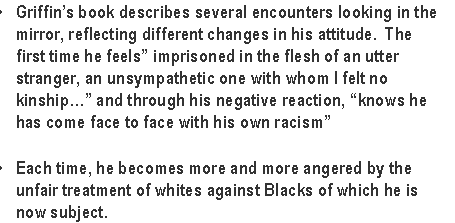
Griffin’s book describes several encounters
looking in the mirror, reflecting different changes in his attitude. The first time he feels” imprisoned in
the flesh of an utter stranger, an unsympathetic one with whom I felt no
kinship…” and through his negative reaction, “knows he has come face to
face with his own racism” |
|
|
|
Each time, he becomes more and more angered by
the unfair treatment of whites against Blacks of which he is now subject. |
|
|
|
|
Whites liked to question him about Black
sexuality and constantly reminded him of his lower place in society |
|
He could only find menial jobs and even when
hired over the phone, he would be turned down when they saw his skin color |
|
He became accustomed to the “Hate Stare” that he
often encountered for no apparent reason other than his skin color |
|
|
|
|
|
|
Griffin did the experiment for about Six Weeks |
|
On his final days in New Orleans, he was
confronted with a ticket agent who would not sell him a ticket, claming she
had no change for a ten dollar bill.
When he didn’t leave, she changed his bill and threw his ticket and
money out the booth onto the ground |
|
Once on the bus, he was vehemently denied by the
bus driver at one stop to go the restroom |
|
|
|
|
Following the Experiment he feared his wife and
children would not see him as the same person anymore, or that through his
experiences, he would feel differently |
|
But he returned home to his family and open arms |
|
After “Black Like Me” was published he faced
protests |
|
He also gave lectures on his experience |
|
He died in 1980 due to complications of Diabetes |
|
|
|
|
|
|
DOT World |
|
Welcome to DOT World |
|
The Most important thing in DOT World is finding
work |
|
Find an Employer and convince them to hire you |
|
They can be stubborn about hiring, so make a
convincing argument |
|
|
|
|
After watching the Video, discuss similarities
in this real life plot to the story the Invisible Man |
|
|
|
What aspects of this story’s events or
characters serve the same function to make the Invisible Man reflect, as in
a Mirror? |
|
|
|

 Notes
Notes