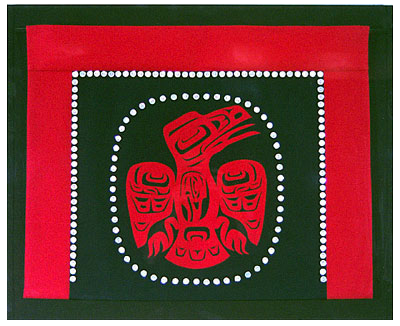
Raven’s Feast
June 12, 2003
Thank you, Letoy.
Good evening. My name
is Julian Argel, and I’m a former officer for the Alaska Native
Brotherhood. I’m Tsimpshian
and Haida. I served as an
Alaska Native Brotherhood officer while I lived in Ketchikan, Alaska,
before I moved here to Seattle in 1988.
I’m presenting in place of the Seattle elected officers Lindsay
Buxton and Donna Bolima who could not be here this evening. I’d like to tell you a little about the Alaska Native
Brotherhood and Sisterhood.
The Alaska Native Brotherhood was organized by a number of
Tsimpshian, Tlingit, and Haida tribal members in Southeast Alaska in 1910. The group came about to foster the camaraderie among Alaska
Native men and women. The
original members were young men and women who had met at the Indian
boarding schools. At
the turn of the century and through the 1960s, the government boarding
school experience was common and many times challenging and harsh, not
always a positive experience for our Native people in Alaska.
As in other tribal communities around the United States, Native
children, from 5, 6, and 7 years of age, were taken away by government
policy and sent to Bureau of Indian Affairs institutions for their
educational experience. They
were gone from Kindergarten through high school graduation.
Away from their own families, these Native children created their
own communities among other boarding school students.
Their peers became their family:
brothers and sisters.
And so, as
graduates, with education and knowledge learned at the boarding schools of
democracy and social justice, these young Native women and men organized
the Alaska Native Brotherhood and Sisterhood to represent the interests of
tribal people in Alaska. Brotherhood
and Sisterhood members have become responsible citizens, and are in a
variety of professions including being: fishermen, cannery workers,
teachers, principals, artists, attorneys, police officers, social workers,
doctors, nurses, judges, college professors, university administrators,
and state legislators. And, they have advocated and promoted social equality and
educational equity for our Native communities through city, school board,
county/borough, state, and federal legislation.
In honor of those students who have strived to get an education,
especially those who have struggled, and have performed well in school,
the Alaska Native Brotherhood and Sisterhood organization and its local
chapters have made scholarships available to support, acknowledge,
encourage, and reward excellence in education among tribal peoples.
The Alaska Native Brotherhood and Sisterhood Seattle Camp want to
recognize 2 students this evening for overcoming great odds and for their
success in education.
The first
student that ANB & ANS wants to acknowledge is one who is a new
graduate from the School of Social Work.
Her Counselor Candace Fries has encouraged this student through her
graduation this week. Out of
a family of 7, this student is the first to obtain a college degree. Taken from her own family when she was young and put in a
government boarding school had a profound impact on her life.
She has become a strong advocate for Indian Child Welfare issues.
A leader in organizing, Cherokee Pettis organized a student group
called “SWINAC” or “Social Workers Involved in Native American
Communities.” To help her
with her future plans for a dual program in Masters in Social Work and
Law, the ANB & ANS would like to award Cherokee Pettis this
scholarship.
The second student that the Alaska Native Brotherhood and Sisterhood want
to award a scholarship to is graduating this year in 2 fields of study: International Studies and Russian. In the first grade, this scholar was diagnosed with Mirror
Dyslexia. Having learned in
spite of that, with perseverance and determination, he graduated from high
school, and entered the University of Washington.
And, in the Spring 2000 Quarter, he went to Vienna on a UW
sponsored travel abroad program, where he learned more of the European
culture and studied the German language.
And with an interest in the Russian language, he planned his own
education by living with a Russian family in Sochi, Russia, and studied at
Moscow State University. During
his undergraduate experience, Matthew Lamm made the Dean’s list 7 times.
Planning on attending law school, Matthew Lamm is planning on
returning to Pine Ridge, South Dakota, to be part of and help his
community. The Alaska Native
Brotherhood and Sisterhood are pleased to award Matthew Lamm this
scholarship award.
TOP |
TOP
TOP
TOP
TOP
TOP |