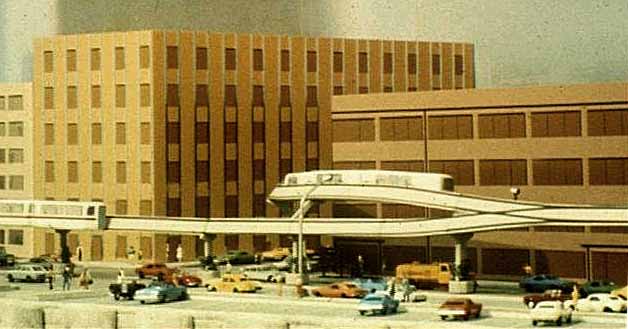
THE NAME "SYSTEM 21" - Derived from the technology's primary feature, two-directional traffic on one slender, triangular " monobeam " guideway. The system is a major breakthrough poised to capture the transit market in the 21st century.
ALL INCLUSIVE SYSTEM COST - Conservatively estimated at $20-25 million per mile, including guideway, stations, vehicles, power substations, switches, maintenance facility and train control system (FUTREX margins are additive). Operating cost will be equal to, or lower than, that of other fixed guideway systems carrying comparable numbers of passengers/hour/direction.
ELEVATED GUIDEWAY - Attractive, triangular steel, concrete or composite guideway , normally 6' wide at the base and 5-1/2' high, is supported on 16' columns; can be higher or lower as required. Does not partition communities, and life goes on uninterrupted underneath. Not visually obtrusive and doesn't block significant sunlight. Ideal for roadway medians and above city streets.
MODULAR CONSTRUCTION - System 21 beams, columns and wayside components are pre-fabricated in a controlled factory setting off-site and shipped to the client's site for installation. The community experiences no prolonged disruption during installation. Because the system is modular, and essentially portable, it can be easily extended into networks. Its portability may also allow System 21 to be the first fully leasable transit system, making it affordable to communities that could not normally afford the significant up-front cost of traditional fixed guideway technologies.
BRANCHING - Through an innovative switch design, based on a standard railroad switch with an active frog and few moving parts, System 21 provides grade separated, tight turn branching and the ability to form efficient transit networks.
MINIMUM CURVE RADIUS - The minimum horizontal turning radius is 90 feet and the minimum vertical curve radius is 300 feet.
AVERAGE FOUNDATIONS - 7'x7'x 2' precast concrete foundations below the surface are anchored to four steel pilings of varying depth, depending on soil conditions. Foundations support a 4' by 6' pedestal which protrudes 1-1/2' out of the ground, serving as the anchorage for guideway columns.
AVERAGE BEAM SPAN AND COLUMN SPACING - 84 feet. Longer (100+ feet) and shorter spans are provided as required.
STATIONS - A typical four car station requires a 12' by 120' landing at grade. Stations are modular and pre-fabricated off-site, or can be built on-site to client specifications. Island platform loading is standard through inboard (beam side) vehicle doors, but loading through outboard vehicle doors to side platforms can be accommodated. Stations are accessed by stairways and elevator.
VEHICLE CAPACITY - Each 28' vehicle has nominal design load of 52 passengers - 24 seated and 28 standing. Vehicle interiors can be reconfigured to suit client's needs (e.g. greater seating or standee capacity, luggage racks, etc.)
TRAIN LENGTH AND SYSTEM CAPACITY - Train length can consist of from one to perhaps as many as ten vehicles, depending on available berthing space at station platforms. System 21 can accommodate more than 12,000 passengers/hour/direction, and trains may be able to operate at headway's of as little as 60 seconds.
VEHICLE SUSPENSION SYSTEM - Side-mounted, cantilevered vehicle suspension places the bulk of the weight on lower steel, main drive wheels (2 per vehicle at 18-foot separation) which ride directly atop a steel rail on either side of the base of the triangular monobeam. To add upright stability, upper outrigger mechanisms (2 per vehicle mounted over the drive wheels) grab and ride along a steel rail, in tension, located on either side of the top of the beam.
VEHICLE DESIGN WEIGHT - Approximately 11,500 lbs. empty, 19,500 lbs. fully loaded.
MAXIMUM GRADE - System 21 vehicles are designed to negotiate 10% grades. The unique suspension configuration will provide sufficient traction to accomplish this in all weather conditions, from a standing start.
MAXIMUM VEHICLE SPEED - Initially 70 mph; later versions may reach 100+ mph.
VEHICLE OPERATION AND TRAIN CONTROL - Using proven, state-of-the-art train control technology, System 21 will safely operate in either a fully-automated or manual , operator supported mode. Central control will monitor all train operations, system activities and passenger handling.
VEHICLE EVACUATION - FUTREX believes that the safest place for passengers during emergencies which require vehicle evacuation is on the ground - not on open, exposed emergency walkways mounted on elevated guideways. To that end, the underside of System 21 vehicles will be used to facilitate stairway evacuation from the vehicle to the ground. In addition, passengers will be able to move from vehicle-to-vehicle in the event a dangerous on-board situation is present. Over waterways and busy highways, or at exceptionally high elevations, FUTREX will introduce an open truss beam configuration which incorporates an emergency walkway internal to the beam.
TRACTION POWER AND PROPULSION - Wayside 750v DC power, distributed along a contact rail mounted under the top outrigger rail mounted on either side of the beam is provided. One wayside power substation would be provided approximately every three miles. Power is supplied by contact rail to the vehicles through outrigger-mounted contact shoes. DC power is converted on-board to supply one three-phase AC, 100 hp motor for each of the two main drive wheels. The segmented power grid will be monitored and operated by Central Control
ALL-WEATHER OPERATION - Weather tested vehicle and guideway components, designed to function in temperature ranges between - 40 and +125 degrees F, and a triangular shaped beam and weather guards preventing the accumulation of snow and ice, will make System 21 ideal for all-weather operations. Designed wind loads, with vehicles on the guideway, is 120 mph.
ACCESSIBILITY TO THE DISABLED - System 21 vehicles and stations are designed to be fully accessible to the disabled.
The above information was provided by FUTREX and is current as of March, 1998
Return to the System 21 home page or the Innovative Transportation Technologies index page.
Last modified: April 4, 1998