andrew cooke
I am a Research Scientist for the Natural Resource Spatial Informatics Group at the University of Washington School of Environmental and Forest Sciences.
I am a GIS analyst and programmer, with experience in:
- FME (Feature Manipulation Engine)
- SQL Server (ArcSDE, stored procedures, spatial views, website/database interactions)
- PostgreSQL
- ArcGIS for Server (live GIS services)
- ArcGIS (network analysis, custom geoprocessing with python and model builder)
- LIDAR processing and analysis
- R (modeling, statistical relationships, raster statistics with RGDAL)
- R Shiny (interactive websites using database backends)
- Cartography
- SQL, Python, R, javascript, Perl, IDL, PHP, VBA, C
- In a previous life, I did a lot of work with: IDL/ENVI, Javad and Trimble GPS systems, Criterion and Impulse laser survey equipment, photogrammetry, and marimba
Education:
- BA Geography, BA Music, University of Washington 2003
- MS Forestry, University of Washington 2008.
My graduate work measured LIDAR ground model accuracy in chaparral and other low, dense vegetation. It was a part of a JFSP funded project to corellate LIDAR and IFSAR vegetation metrics with the burn intensity of wildfires.
CMER Riparian Vegetation Monitoring (Ongoing; 2015 to present)
LIDAR for stratified forest inventory sampling (Ongoing; 2010 to present)
The purpose of this project was to develop a GIS-based protocol for ground plot selection in areas with high-density LIDAR coverage, and determine if LIDAR derived forest structure metrics are an appropriate basis to locate field plots? If so, field plots based on LIDAR stratification will provide an appropriate sample to describe forest conditions.
Field crews have collected plot information at the locations developed using our methods, and databases of all the field crew plot data were developed and have been used as the basis for lidar-based inventory models.
This project has been performed in multiple stages, over several years:
- 2010 (Coos Bay): a study area of approximately 250,000 acres of BLM and Coquille tribal lands in the south Oregon coastal forests. The study area was contained within a 1.6 million acre LIDAR acquisition collected in 2008 and 2009.
- 2013 (Rogue Valley): a study area of approximately 640,000 acres of BLM land in the south Oregon Cascades. This study area is contained within a 1.4 million acre LIDAR acquisition collected in 2012.
- 2017: a three part study area (Lane County, Upper Rogue, Upper Umpqua) of approximately 920,000 acres of BLM and Oregon Department of Forestry lands in southwestern Oregon. These study areas are contained within 4.7 million acres of LIDAR acquired between 2013 and 2015.
We have performed similar work for:
- the Forest Service and NASA as part of a Carbon Monitoring System project in 2015, locating plots across 6 Landsat scenes in 6 states, by processing and stratifying strips of LIDAR within each scene
- the Sealaska Corporation and the Nature Conservancy in southeast Alaska in 2016
- the Washington DNR as part of a Riparian Vegetation Monitoring Project in 2017
- the Forest Service and the Nature Conservancy on Prince of Wales Island in southeast Alaska in 2018
Developed in collaboration with the USDA Forest Service PNW Research Station, with support from the U.S. Bureau of Land Management.
 more
more
Washington State Historic Timber Harvest (2015)
This project was developed as a way to visualize changes in timber harvests (both volumes and locations) over time in Washington State. Historical timber harvest volume data is available from the Washington State Department of Natural Resources (DNR), but harvest locations are not.
Spatial locations for the harvests on public lands were developed from the Public Land Inventory database developed for the Washington State Recreation and Conservation Office (RCO). Private Ownership data came from a derivative of the 2012 Washington State Parcel Database developed for the DNR as part of the Washington Biomass Assessment. Land ownership polygons were combined with county polygons, creating polygons for each owner class in each county.
Using a ‘Dot Density’ symbology, the combined owner class/county polygons were filled with dots based on the timber harvest volume for each owner class in each county in each year. Fewer dots represent less volume, more dots represent more volume.
more
Public Land Inventory (2013 to 2014)
The Public Lands Inventory is intended as a tool for Washingtonians to better understand the location, use, and purchase price of recreation and natural resource lands owned and managed by federal, state, and local governments. The inventory also helps state agencies better collaborate and manage these lands by revealing current and future opportunities for partnerships.
The Public Lands Inventory is a web-accessible interactive map. This is the first web-based interactive mapping application for public lands for the state. The inventory includes ownership, location, and acreage information for each parcel, and the intended use at the time of acquisition, the current use, acquisition cost, and funding sources for lands acquired by state agencies within the past 10 years.
Developed in collaboration with the Washinton Recreation and Conservation Office, the Washington Department of Natural Resources, the Washington Department of Fish and Wildlife, Washington State Parks, and GeoEngineers
more
Advanced Hardwood Biofuels Northwest (2010 to 2016)
Advanced Hardwood Biofuels Northwest (AHB) is a USDA National Institute of Food and Agriculture (NIFA) funded consortium of universities and industry partners working to develop a Pacific Northwest biofuel industry that provides 100% renewable and infrastructure-compatible transportation fuels derived from sustainably grown hardwoods.
We developed a regional land ownership database for Montana, Idaho, Washington, Oregon, and California, which was used to identify suitable poplar habitat. The locations and amounts of habitat were used in economic, transportation, and crop displacement models, and for outreach and training efforts by WSU Extension agents.
more
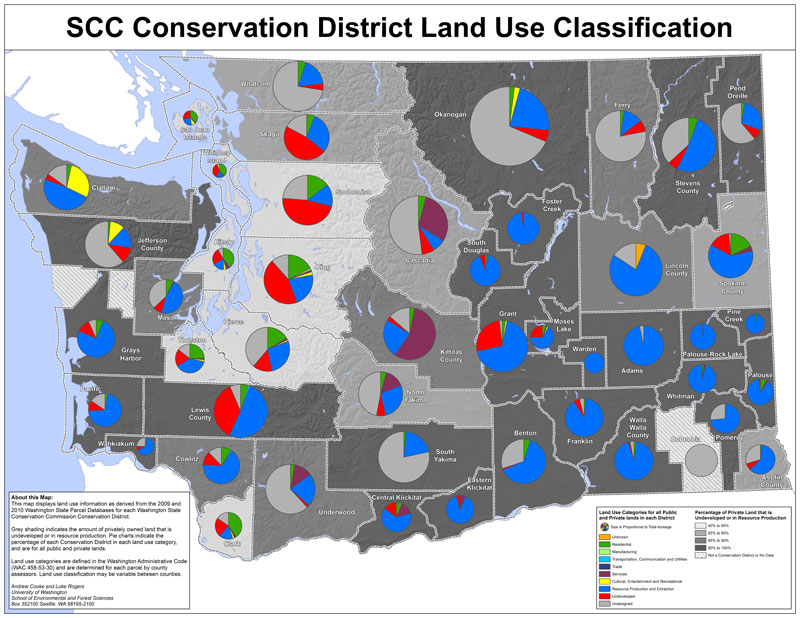
Washington State Parcel Database (Ongoing; 2008 to present)
Begun in 2007, the WSPD is an ongoing effort to build and maintain a single, statewide, GIS-based parcel dataset for Washington. In doing so this project reduces redundant efforts by separate agencies, provides a common dataset for all parcel data users, reduces data production burdens on individual counties, and provides support for data development to counties.
Parcel data and assessor attributes from the state's 39 counties, as well as the Washington Department of Natural Resources, the Washington Department of Fish and Wildlife, the U.S. Bureau of Land Management, and the U.S. Forest Service are collected and normalized into a common statewide format. All incoming data and all data translations are documented and made available on the project website.
Currently 66 agencies are using the WSPD for 257 different projects.
Developed with support from the Washingon State Department of Health, the USDA Forest Service, the Washington State Department of Revenue, and the Federal Geographic Data Committee Cadastral Subcommittee
more
Sealaska Riparian Assessment (2013 to 2014)
This project quantified and characterized riparian stand conditions along all streams (approx. 1000 miles) on Sealaska Corporation lands (approx. 290,000 ac) in southeast Alaska. These data would be used along with results from the habitat trend study to assess the overall cumulative effects of timber harvest on riparian potential to maintain ecological functions and salmonid habitat on Sealaska lands. The data was attributed in a GIS database and suitable for queries (e.g., determine proportion of streams with buffer strips, or quantify riparian functional status for supplying large wood and shade) and development of map products.
Developed in partnership with the Sealaska Corporation and Martin Environmental
more
Marine Spatial Planning (2013)
The State of Washington is undertaking an interagency effort to integrate spatial data into planning efforts for marine waters. Marine resources in Washington are currently managed by a variety of local, state, tribal and federal authorities. This effort aims to create a comprehensive plan coordinated across agencies.
We developed shoreline environmental designation data for Pacific County, processed bathymetry data from multiple sources, developed hillshade datasets, and converted UW School of Oceanography Pacific Ocean data from their models into GIS datasets. This data was made publically available through an ArcGIS Server web service
Developed in partnership with the UW Olympic Natural Resources Center, with support from the Washingon State Department of Natural Resources
more
Washington Forest Biomass Supply Assessment (2011-2012)
The Washington Biomass Calcultor
Three major goals were accomplished with the study:
- Estimate the volume of forest biomass (whether it was removed or retained on site), stratified by land ownership categories, forest ecosystem types, tree species, and location.
- Assesses biomass market availability based on various cost and price considerations, and calculate the value of the available biomass to the landowners.
- Provide public access to the biomass database via a web-based calculator tool
The research team studied the process of biomass production beginning with forest harvest operations, calculating the volume of biomass at all stages of processing and inferring the contribution made to market uses and ecological function when it was retained on site.
The report also studied alternative scenarios regarding fuels treatment and forest health in National Forests in eastern Washington. The scenarios reflected a future in which the number of acres treated for fuels reduction and forest health reasons is increased.
A comprehensive road network for transporting biomass to market was developed for this project. Two road datasets, one for forest roads and a routable street network, were combined using a custom FME workbench that removed duplicate line segments and snapped remaining roads segements together within iteratively increasing tolerances until all segments were connected.
Developed for the Washington State Department of Natural Resources with support from the USDA Forest Service
more
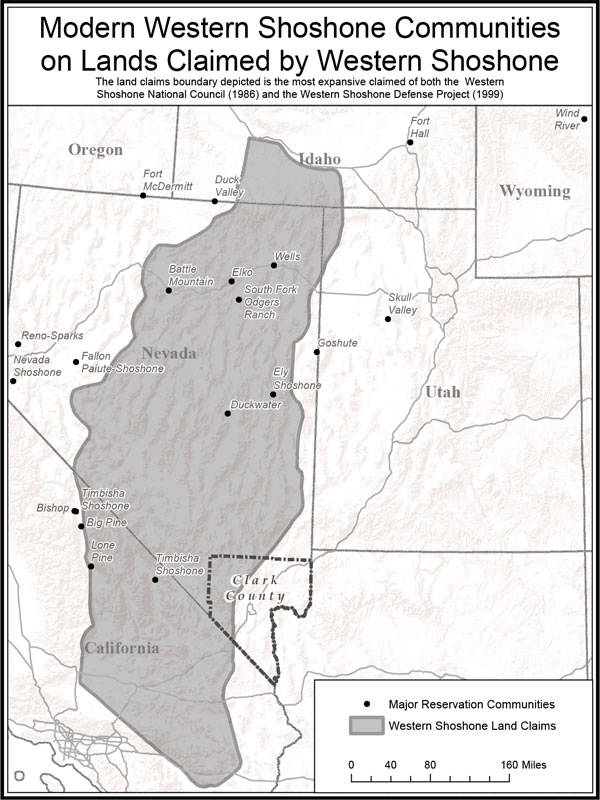
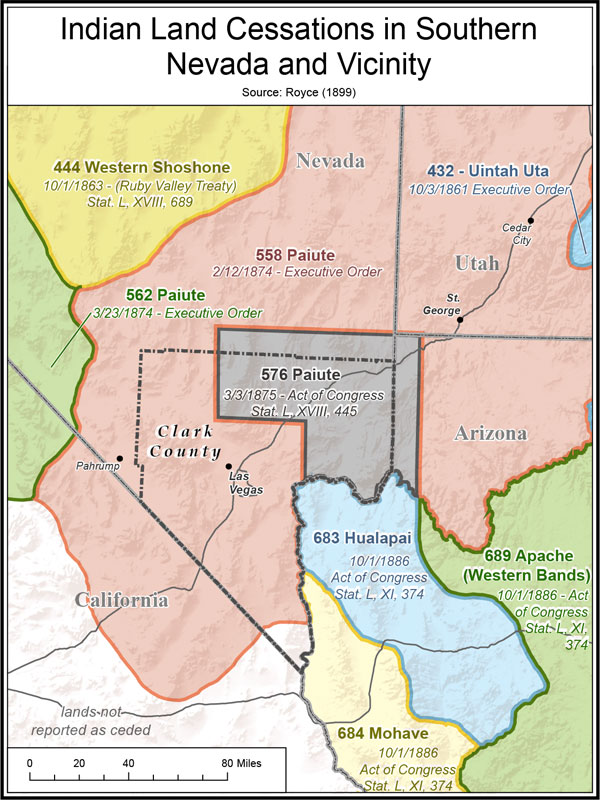
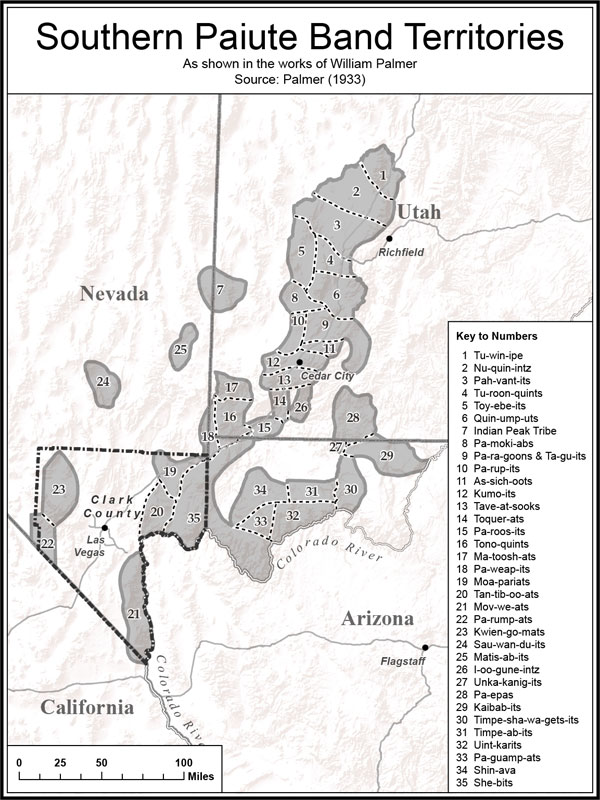
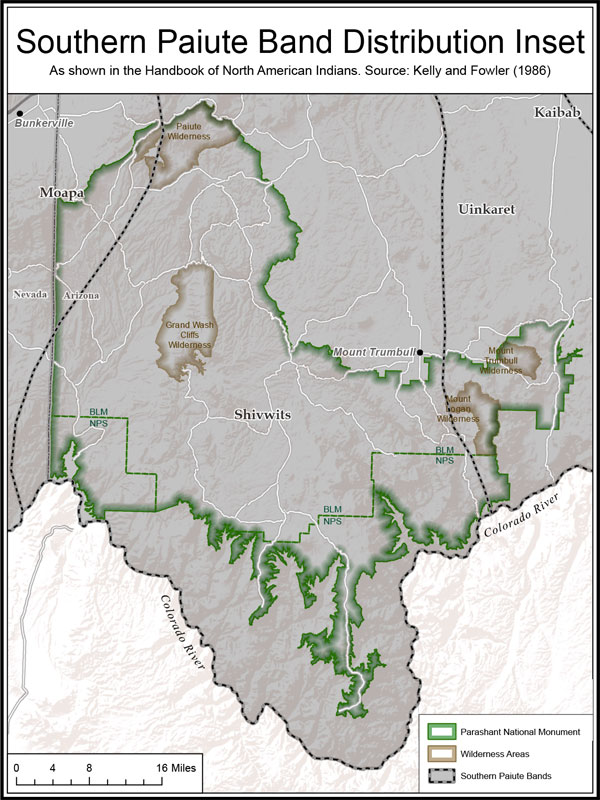
Southern Nevada Historic Tribal Boundary Mapping (2011)
The purpose of this project was to create two series of maps juxtaposing the historic boundaries of tribal territories with contemporary public lands, including the National Park Service, the USDA Forest Service, the Bureau of Land Management, the Bureau of Reclamation, and the U.S. Fish and Wildlife Service. The goal, in many of these maps, was to help land managers understand how historic tribal territories relate to their current jurisdictions. Each series contained a dozen maps, the first series of maps focusing on Clark County, NV, and the second focusing on the Grand Canyon-Parashant National Monument.
Historica land claim data were digitized from a variety of historic records, and combined with ownership boundaries, major rivers and highways, and cities. These maps are published in a final report.
Developed with support from the National Park Service
more
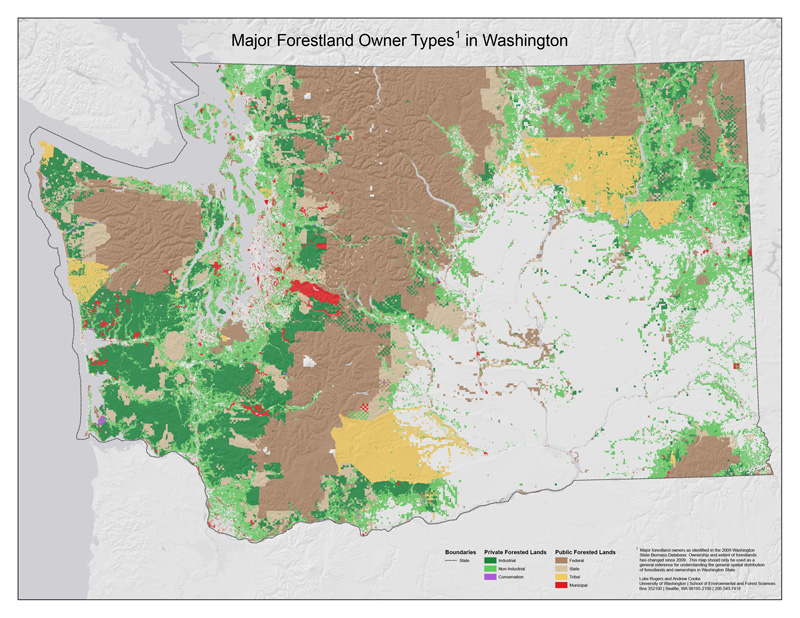
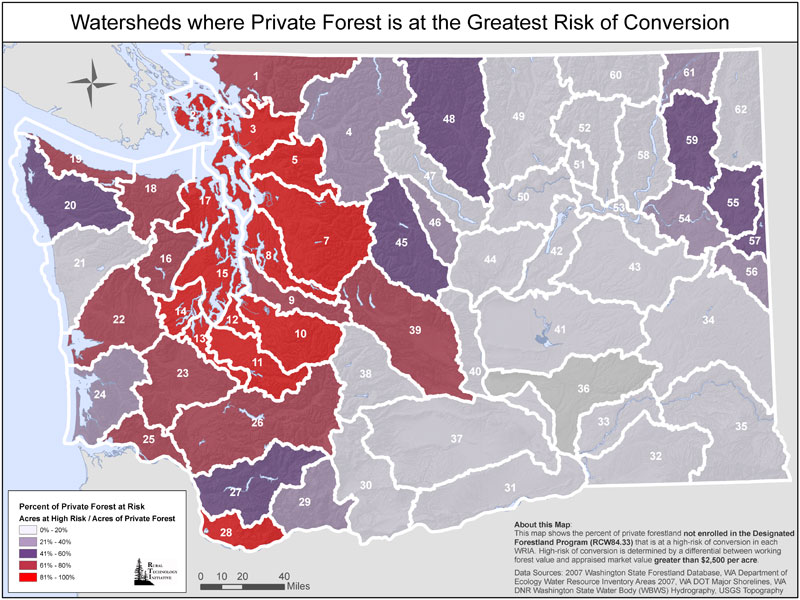
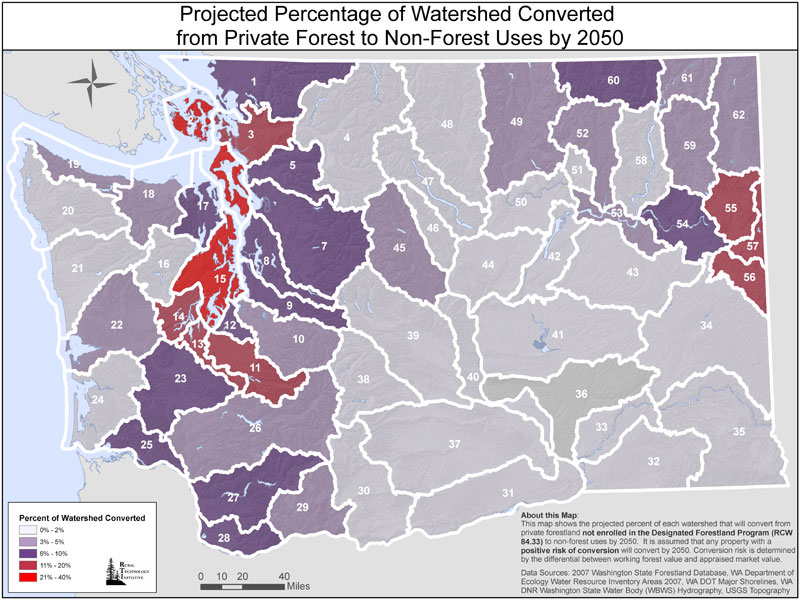
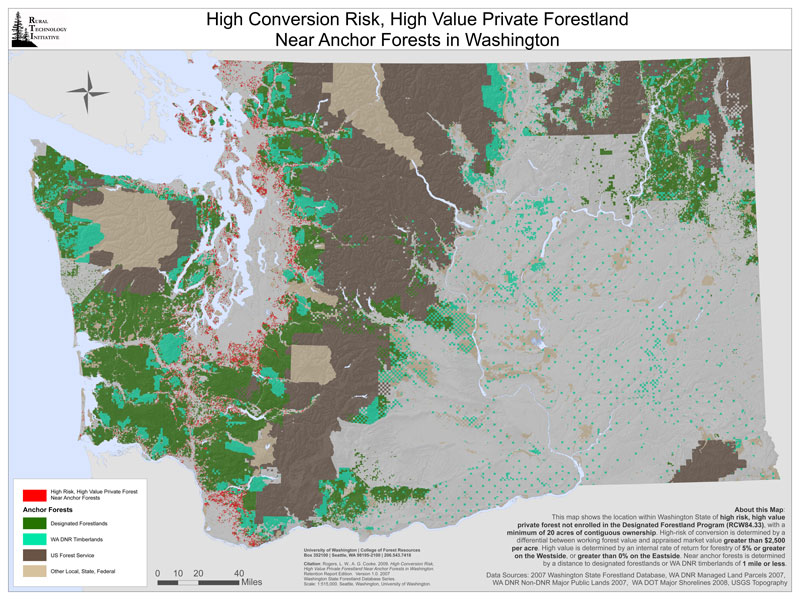
Retention of High-Valued Forest Lands at Risk of Conversion to Non-Forest Uses in Washington State (2008)
This is a paper prepared for the Washington State Legislature and Washington Department of Natural Resources. It was written as part of the 2008 Northwest Environmental Forum and was based heavily on analysis work performed by our group using the Washington State Forestland Database.
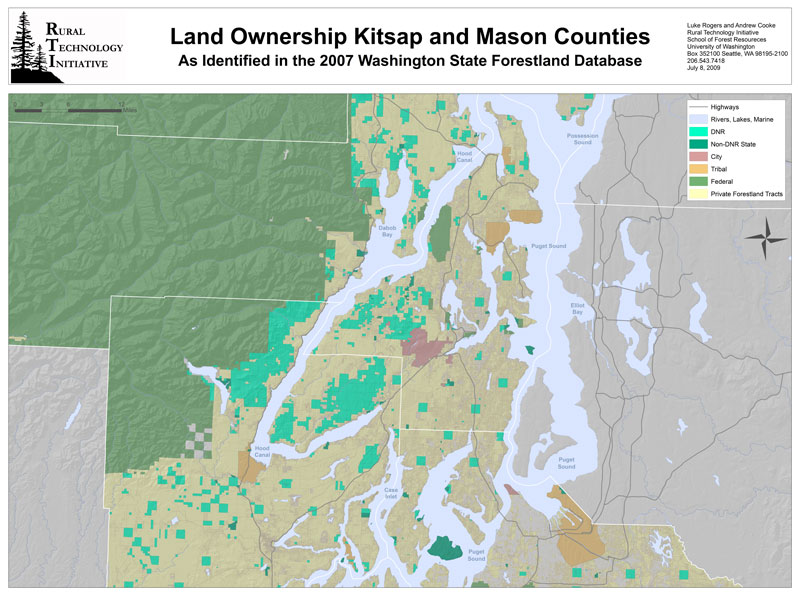
Washington State Forestland Database (2008)
This project was an attempt to map and quantify the forestlands, both public and private, of Washington State. Based on the 2007 Washington State Parcel Database, parcels were categorized into different owner classes and management types, based on ownership information. This data was then combined with stream and waterbody locations, forest practice restrictions, forest land cover data, and information about owner particpation in forestland tax programs.
The combination of all of this data was used to model the potential economic trade-offs for land owners by comparing the present value of potential future timber harvests to the present value of developing the parcel to a non-forestry use.
A major hurdle in this project was the development of a statewide dataset that describes the complex Forest and Fish Law riparaian buffer requirements on the landscape. These buffers vary in size depending on: whether or not these water features contain suitable fish habitat, whether or not they have water year round, the productivity of the soil around a water feature, and the location of the water feature in the State.
Developed under contract with the USDA Forest Service, in Partnership with the Family Forest Foundation and the Washington State Farm Forestry Association
more
Older Projects:
- Testing LIDAR accuracy in chaparral for the Joint Fire Science Program
- Developing a LIDAR DEM algorithm
- Developing vegetation metrics for chaparral from LIDAR and IFSAR data
- Developing GPS field data collection protocol using LIDAR data and GIS
- Planning, organizing, and running a field data collection trip to Southern California
- Helping to develop LIDAR processing software to measure attributes for individual trees
- Surveying forest plots and building data sets for two JFSP forest fire studies with PFC and the USDA Forest Service Pacific Northwest Research Station, one in the Wenatchee National Forest and one in Southern California.
- Processing, importing, and mapping LIDAR data sets
- Designing and maintaining the PFC webpage
- Assisting with inertial navigation research
I have also worked at Weyerhaeuser on the Forestry Systems IT team, providing support for: GPS, remote sensing and aerial imagery, GIS software, licensing and datasets, training, and standards/best-practices development.
- Kate Legner, Hans-Erik Andersen, Andrew Cooke, Warren Cohen. 2020. A cost-effective field measurement protocol to support lidar-assisted carbon monitoring programs - implementing a prototype design at six different sites in the United States. https://doi.org/10.2737/PNW-GTR-984. Gen. Tech. Rep. PNW-GTR-984. Portland, OR: U.S. Department of Agriculture, Forest Service, Pacific Northwest Research Station. 66 p.
- Noelle M. Hart, Patricia A. Townsend, Amira Chowyuk, and Rick Gustafson. 2018. Stakeholder Assessment of the Feasibility of Poplar as a Biomass Feedstock and Ecosystem Services Provider in Southwestern Washington, USA. Forests. 2018; 9(10):655. https://doi.org/10.3390/f9100655
- Moskal, L. Monika, A.G. Cooke, T. Axe, J.M. Comnick. 2017. Extensive Riparian Vegetation Monitoring – Remote Sensing Pilot Study. Prepared for the Department of Natural Resources Cooperative Monitoring, Evaluation, and Research Committee by the University of Washington School of Environmental and Forest Sciences.
- Rogers, Luke W., A.G. Cooke, J.M. Comnick. 2016. Advanced Hardwood Biofuels Northwest: A Poplar Suitability and Parcel Land Use Study.
- 2014. Washington Public Land Inventory Final Report. Prepared for the Washington State Legislature and the Recreation and Conservation Office.
- Cooke, Andrew G. and M.R. McLaughlin. 2012. The Evolution of the Washington State Forestland Database Project Western Forester. Volume 57, No. 1. Pages 10-11.
- John Perez-Garcia et. al. 2012. Washington Forest Biomass Supply Assessment. Prepared for Washington Department of Natural Resources by University of Washington, College of the Environment, School of Environmental and Forest Sciences and TSS Consultants with financial support from USDA Forest Service.
- Rogers, Luke W. and A.G. Cooke. 2009. The 2007 Washington State Forestland Database Final Report. Prepared under contract for the USDA Forest Service. University of Washington College of Forest Resources, Seattle, WA.
- Bradley, Gordon, et al. 2009. Retention of High-Valued Forest Lands at Risk of Conversion to Non-Forest Uses in Washington State. Prepared for the Washington State Senate and Washington Department of Natural Resources by the University of Washington College of Forest Resources.
- McGaughey, Robert J., A.G. Cooke, H.E. Andersen, S.E. Reutebuch. 2009. Mapping and Analysis of Pre-Fire Fuels Loading and Burn Intensity using Pre-Fire Interferometric Synthetic Aperture Radar Data combined with Burn Intensity derived from Post-Fire Multispectural Imagery for the 2003 Southern CA. Fires. Final Report to the Joint Fire Science Program March 2009. JFSP Project Number 04-1-2-02.
- Cooke, Andrew G. 2008. Analysis of LIDAR-derived bare ground model accuracy in southern California chaparral. Masters Thesis. University of Washington, Seattle, WA.